import fine as fn
import numpy as np
import pandas as pd

%load_ext autoreload
%autoreload 2
Water supply of a small mountain village
Two new houses (house 5 and 6) were built in a small mountain village in Utopia which requires an update of the existing clean water supply system of the village which now consists of 6 houses:
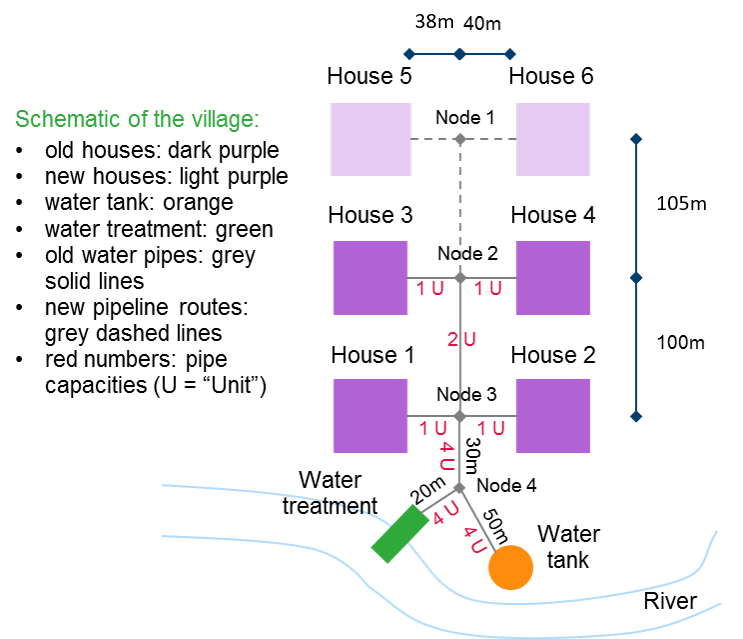
Water demand
The demand for clean water occurs in spring between 5 am and 11 pm, in summer between 4 am and 12 pm, in autumn between 5 am and 11 pm and in winter between 6 am and 11 pm. The demand for one house assumes random values between 0 to 1 Uh (Unit*hour) during the demand hours. These values are uniformly distributed and are 0 outside the demand hours.
Water supply
The water supply comes from a small tributary of a glacier river, which provides more water in summer and less in winter: the profile is given for each hour of the year as
f(t) = 8 * sin(π*t/8760) + g(t)
where g(t) is a uniformly distributed random value between 0 and 4.
Water storage
Clean water can be stored in a water tank (newly purchased). The invest per capacity is 100€/Uh, the economic lifetime is 20 years.
Water treatment
The river water is converted to clean water in a water treatment plant (newly purchased). The invest per capacity is 7000€/U, the economic lifetime is 20 years. Further, it needs some electricity wherefore it has operational cost of 0.05 €/U.
Water transmission
The clean water can be transported via water pipes, where some already exist between the houses 1-4, the water treatment plant and the water tank, however new ones might need to be built to connect the newly built houses or reinforce the transmission along the old pipes. The invest for new pipes per capacity is 100 €/(m*U), the invest if a new pipe route is built is 500 €/(m*U), the economic lifetime is 20 years.
locations = [
    "House 1",
    "House 2",
    "House 3",
    "House 4",
    "House 5",
    "House 6",
    "Node 1",
    "Node 2",
    "Node 3",
    "Node 4",
    "Water treatment",
    "Water tank",
]
commodityUnitDict = {"clean water": "U", "river water": "U"}
commodities = {"clean water", "river water"}
numberOfTimeSteps = 8760
hoursPerTimeStep = 1
esM = fn.EnergySystemModel(
    locations=set(locations),
    commodities=commodities,
    numberOfTimeSteps=8760,
    commodityUnitsDict=commodityUnitDict,
    hoursPerTimeStep=1,
    costUnit="1e3 Euro",
    lengthUnit="m",
)
Source
riverFlow = pd.DataFrame(np.zeros((8760, 12)), columns=locations)
np.random.seed(42)
riverFlow.loc[:, "Water treatment"] = np.random.uniform(0, 4, (8760)) + 8 * np.sin(
    np.pi * np.arange(8760) / 8760
)
esM.add(
    fn.Source(
        esM=esM,
        name="River",
        commodity="river water",
        hasCapacityVariable=False,
        operationRateMax=riverFlow,
        opexPerOperation=0.05,
    )
)
Conversion
eligibility = pd.Series([0, 0, 0, 0, 0, 0, 0, 0, 0, 0, 1, 0], index=locations)
esM.add(
    fn.Conversion(
        esM=esM,
        name="Water treatment plant",
        physicalUnit="U",
        commodityConversionFactors={"river water": -1, "clean water": 1},
        hasCapacityVariable=True,
        locationalEligibility=eligibility,
        investPerCapacity=7,
        opexPerCapacity=0.02 * 7,
        interestRate=0.08,
        economicLifetime=20,
    )
)
Storage
eligibility = pd.Series([0, 0, 0, 0, 0, 0, 0, 0, 0, 0, 0, 1], index=locations)
esM.add(
    fn.Storage(
        esM=esM,
        name="Water tank",
        commodity="clean water",
        hasCapacityVariable=True,
        chargeRate=1 / 24,
        dischargeRate=1 / 24,
        locationalEligibility=eligibility,
        investPerCapacity=0.10,
        opexPerCapacity=0.02 * 0.1,
        interestRate=0.08,
        economicLifetime=20,
    )
)
Transmission
Distances between eligible regions
distances = np.array(
    [
        [0, 0, 0, 0, 0, 0, 0, 0, 38, 0, 0, 0],
        [0, 0, 0, 0, 0, 0, 0, 0, 40, 0, 0, 0],
        [0, 0, 0, 0, 0, 0, 0, 38, 0, 0, 0, 0],
        [0, 0, 0, 0, 0, 0, 0, 40, 0, 0, 0, 0],
        [0, 0, 0, 0, 0, 0, 38, 0, 0, 0, 0, 0],
        [0, 0, 0, 0, 0, 0, 40, 0, 0, 0, 0, 0],
        [0, 0, 0, 0, 38, 40, 0, 105, 0, 0, 0, 0],
        [0, 0, 38, 40, 0, 0, 105, 0, 100, 0, 0, 0],
        [38, 40, 0, 0, 0, 0, 0, 100, 0, 30, 0, 0],
        [0, 0, 0, 0, 0, 0, 0, 0, 30, 0, 20, 50],
        [0, 0, 0, 0, 0, 0, 0, 0, 0, 20, 0, 0],
        [0, 0, 0, 0, 0, 0, 0, 0, 0, 50, 0, 0],
    ]
)

distances = pd.DataFrame(distances, index=locations, columns=locations)
distances
| House 1 | House 2 | House 3 | House 4 | House 5 | House 6 | Node 1 | Node 2 | Node 3 | Node 4 | Water treatment | Water tank | |
|---|---|---|---|---|---|---|---|---|---|---|---|---|
| House 1 | 0 | 0 | 0 | 0 | 0 | 0 | 0 | 0 | 38 | 0 | 0 | 0 |
| House 2 | 0 | 0 | 0 | 0 | 0 | 0 | 0 | 0 | 40 | 0 | 0 | 0 |
| House 3 | 0 | 0 | 0 | 0 | 0 | 0 | 0 | 38 | 0 | 0 | 0 | 0 |
| House 4 | 0 | 0 | 0 | 0 | 0 | 0 | 0 | 40 | 0 | 0 | 0 | 0 |
| House 5 | 0 | 0 | 0 | 0 | 0 | 0 | 38 | 0 | 0 | 0 | 0 | 0 |
| House 6 | 0 | 0 | 0 | 0 | 0 | 0 | 40 | 0 | 0 | 0 | 0 | 0 |
| Node 1 | 0 | 0 | 0 | 0 | 38 | 40 | 0 | 105 | 0 | 0 | 0 | 0 |
| Node 2 | 0 | 0 | 38 | 40 | 0 | 0 | 105 | 0 | 100 | 0 | 0 | 0 |
| Node 3 | 38 | 40 | 0 | 0 | 0 | 0 | 0 | 100 | 0 | 30 | 0 | 0 |
| Node 4 | 0 | 0 | 0 | 0 | 0 | 0 | 0 | 0 | 30 | 0 | 20 | 50 |
| Water treatment | 0 | 0 | 0 | 0 | 0 | 0 | 0 | 0 | 0 | 20 | 0 | 0 |
| Water tank | 0 | 0 | 0 | 0 | 0 | 0 | 0 | 0 | 0 | 50 | 0 | 0 |
Old water pipes
capacityFix = np.array(
    [
        [0, 0, 0, 0, 0, 0, 0, 0, 1, 0, 0, 0],
        [0, 0, 0, 0, 0, 0, 0, 0, 1, 0, 0, 0],
        [0, 0, 0, 0, 0, 0, 0, 1, 0, 0, 0, 0],
        [0, 0, 0, 0, 0, 0, 0, 1, 0, 0, 0, 0],
        [0, 0, 0, 0, 0, 0, 0, 0, 0, 0, 0, 0],
        [0, 0, 0, 0, 0, 0, 0, 0, 0, 0, 0, 0],
        [0, 0, 0, 0, 0, 0, 0, 0, 0, 0, 0, 0],
        [0, 0, 1, 1, 0, 0, 0, 0, 2, 0, 0, 0],
        [1, 1, 0, 0, 0, 0, 0, 2, 0, 4, 0, 0],
        [0, 0, 0, 0, 0, 0, 0, 0, 4, 0, 4, 4],
        [0, 0, 0, 0, 0, 0, 0, 0, 0, 4, 0, 0],
        [0, 0, 0, 0, 0, 0, 0, 0, 0, 4, 0, 0],
    ]
)

capacityFix = pd.DataFrame(capacityFix, index=locations, columns=locations)
capacityFix
| House 1 | House 2 | House 3 | House 4 | House 5 | House 6 | Node 1 | Node 2 | Node 3 | Node 4 | Water treatment | Water tank | |
|---|---|---|---|---|---|---|---|---|---|---|---|---|
| House 1 | 0 | 0 | 0 | 0 | 0 | 0 | 0 | 0 | 1 | 0 | 0 | 0 |
| House 2 | 0 | 0 | 0 | 0 | 0 | 0 | 0 | 0 | 1 | 0 | 0 | 0 |
| House 3 | 0 | 0 | 0 | 0 | 0 | 0 | 0 | 1 | 0 | 0 | 0 | 0 |
| House 4 | 0 | 0 | 0 | 0 | 0 | 0 | 0 | 1 | 0 | 0 | 0 | 0 |
| House 5 | 0 | 0 | 0 | 0 | 0 | 0 | 0 | 0 | 0 | 0 | 0 | 0 |
| House 6 | 0 | 0 | 0 | 0 | 0 | 0 | 0 | 0 | 0 | 0 | 0 | 0 |
| Node 1 | 0 | 0 | 0 | 0 | 0 | 0 | 0 | 0 | 0 | 0 | 0 | 0 |
| Node 2 | 0 | 0 | 1 | 1 | 0 | 0 | 0 | 0 | 2 | 0 | 0 | 0 |
| Node 3 | 1 | 1 | 0 | 0 | 0 | 0 | 0 | 2 | 0 | 4 | 0 | 0 |
| Node 4 | 0 | 0 | 0 | 0 | 0 | 0 | 0 | 0 | 4 | 0 | 4 | 4 |
| Water treatment | 0 | 0 | 0 | 0 | 0 | 0 | 0 | 0 | 0 | 4 | 0 | 0 |
| Water tank | 0 | 0 | 0 | 0 | 0 | 0 | 0 | 0 | 0 | 4 | 0 | 0 |
The old pipes have many leckages wherefore they lose 0.1%/m of the water they transport.
isBuiltFix = capacityFix.copy()
isBuiltFix[isBuiltFix > 0] = 1

esM.add(
    fn.Transmission(
        esM=esM,
        name="Old water pipes",
        commodity="clean water",
        losses=0.1e-2,
        distances=distances,
        hasCapacityVariable=True,
        hasIsBuiltBinaryVariable=True,
        bigM=100,
        capacityFix=capacityFix,
        isBuiltFix=isBuiltFix,
    )
)
New water pipes
incidence = np.array(
    [
        [0, 0, 0, 0, 0, 0, 0, 0, 1, 0, 0, 0],
        [0, 0, 0, 0, 0, 0, 0, 0, 1, 0, 0, 0],
        [0, 0, 0, 0, 0, 0, 0, 1, 0, 0, 0, 0],
        [0, 0, 0, 0, 0, 0, 0, 1, 0, 0, 0, 0],
        [0, 0, 0, 0, 0, 0, 1, 0, 0, 0, 0, 0],
        [0, 0, 0, 0, 0, 0, 1, 0, 0, 0, 0, 0],
        [0, 0, 0, 0, 1, 1, 0, 1, 0, 0, 0, 0],
        [0, 0, 1, 1, 0, 0, 1, 0, 1, 0, 0, 0],
        [1, 1, 0, 0, 0, 0, 0, 1, 0, 1, 0, 0],
        [0, 0, 0, 0, 0, 0, 0, 0, 1, 0, 1, 1],
        [0, 0, 0, 0, 0, 0, 0, 0, 0, 1, 0, 0],
        [0, 0, 0, 0, 0, 0, 0, 0, 0, 1, 0, 0],
    ]
)

eligibility = pd.DataFrame(incidence, index=locations, columns=locations)
eligibility
| House 1 | House 2 | House 3 | House 4 | House 5 | House 6 | Node 1 | Node 2 | Node 3 | Node 4 | Water treatment | Water tank | |
|---|---|---|---|---|---|---|---|---|---|---|---|---|
| House 1 | 0 | 0 | 0 | 0 | 0 | 0 | 0 | 0 | 1 | 0 | 0 | 0 |
| House 2 | 0 | 0 | 0 | 0 | 0 | 0 | 0 | 0 | 1 | 0 | 0 | 0 |
| House 3 | 0 | 0 | 0 | 0 | 0 | 0 | 0 | 1 | 0 | 0 | 0 | 0 |
| House 4 | 0 | 0 | 0 | 0 | 0 | 0 | 0 | 1 | 0 | 0 | 0 | 0 |
| House 5 | 0 | 0 | 0 | 0 | 0 | 0 | 1 | 0 | 0 | 0 | 0 | 0 |
| House 6 | 0 | 0 | 0 | 0 | 0 | 0 | 1 | 0 | 0 | 0 | 0 | 0 |
| Node 1 | 0 | 0 | 0 | 0 | 1 | 1 | 0 | 1 | 0 | 0 | 0 | 0 |
| Node 2 | 0 | 0 | 1 | 1 | 0 | 0 | 1 | 0 | 1 | 0 | 0 | 0 |
| Node 3 | 1 | 1 | 0 | 0 | 0 | 0 | 0 | 1 | 0 | 1 | 0 | 0 |
| Node 4 | 0 | 0 | 0 | 0 | 0 | 0 | 0 | 0 | 1 | 0 | 1 | 1 |
| Water treatment | 0 | 0 | 0 | 0 | 0 | 0 | 0 | 0 | 0 | 1 | 0 | 0 |
| Water tank | 0 | 0 | 0 | 0 | 0 | 0 | 0 | 0 | 0 | 1 | 0 | 0 |
The new are pipes are better but still lose 0.05%/m of the water they transport.
esM.add(
    fn.Transmission(
        esM=esM,
        name="New water pipes",
        commodity="clean water",
        losses=0.05e-2,
        distances=distances,
        hasCapacityVariable=True,
        hasIsBuiltBinaryVariable=True,
        bigM=100,
        locationalEligibility=eligibility,
        investPerCapacity=0.1,
        investIfBuilt=0.5,
        interestRate=0.08,
        economicLifetime=50,
    )
)
Sink
winterHours = np.append(range(8520, 8760), range(1920))
springHours, summerHours, autumnHours = (
    np.arange(1920, 4128),
    np.arange(4128, 6384),
    np.arange(6384, 8520),
)

demand = pd.DataFrame(np.zeros((8760, 12)), columns=list(locations))
np.random.seed(42)
demand[locations[0:6]] = np.random.uniform(0, 1, (8760, 6))

demand.loc[winterHours[(winterHours % 24 < 5) | (winterHours % 24 >= 23)]] = 0
demand.loc[springHours[(springHours % 24 < 4)]] = 0
demand.loc[summerHours[(summerHours % 24 < 5) | (summerHours % 24 >= 23)]] = 0
demand.loc[autumnHours[(autumnHours % 24 < 6) | (autumnHours % 24 >= 23)]] = 0
np.float64(demand.sum().sum())
np.float64(19955.415289775883)
esM.add(
    fn.Sink(
        esM=esM,
        name="Water demand",
        commodity="clean water",
        hasCapacityVariable=False,
        operationRateFix=demand,
    )
)
Optimize the system
esM.aggregateTemporally(numberOfTypicalPeriods=7)
Clustering time series data with 7 typical periods and 24 time steps per period
further clustered to 12 segments per period...
		(6.9524 sec)
# esM.optimize(timeSeriesAggregation=True, optimizationSpecs='LogToConsole=1 OptimalityTol=1e-6 crossover=1')
esM.optimize(
    timeSeriesAggregation=True,
    solver=fn.utils.ImplementedSolvers.STANDARD_SOLVER.value,
)
Time series aggregation specifications:
Number of typical periods:7, number of time steps per period:24, number of segments per period:12

Declaring sets, variables and constraints for SourceSinkModel
	declaring sets...
	declaring variables...
	declaring constraints...
		(0.0352 sec)

Declaring sets, variables and constraints for ConversionModel
	declaring sets...
	declaring variables...
	declaring constraints...
		(0.0110 sec)

Declaring sets, variables and constraints for StorageModel
	declaring sets...
	declaring variables...
	declaring constraints...
		(0.1011 sec)

Declaring sets, variables and constraints for TransmissionModel
	declaring sets...
	declaring variables...
	declaring constraints...
		(0.0749 sec)

Declaring shared potential constraint...
		(0.0013 sec)

Declaring linked component quantity constraint...
		(0.0000 sec)

Declaring commodity balances...
		(0.0485 sec)

		(0.0000 sec)

Declaring objective function...
		(0.1560 sec)

WARNING: Could not locate the 'glpsol' executable, which is required for
solver 'glpk'
---------------------------------------------------------------------------
ApplicationError                          Traceback (most recent call last)
Cell In[17], line 2
      1 # esM.optimize(timeSeriesAggregation=True, optimizationSpecs='LogToConsole=1 OptimalityTol=1e-6 crossover=1')
----> 2 esM.optimize(timeSeriesAggregation=True, solver="glpk")

File C:\Programming\FINE\fine\energySystemModel.py:2077, in EnergySystemModel.optimize(self, declaresOptimizationProblem, relaxIsBuiltBinary, timeSeriesAggregation, logFileName, threads, solver, timeLimit, optimizationSpecs, warmstart, relevanceThreshold, includePerformanceSummary)
   2075 elif solver == "glpk":
   2076     optimizer.set_options(optimizationSpecs)
-> 2077     solver_info = optimizer.solve(self.pyM, tee=True)
   2078 else:
   2079     solver_info = optimizer.solve(self.pyM, tee=True)

File c:\Users\j.belina\AppData\Local\miniforge3\envs\fine_22_09_25\Lib\site-packages\pyomo\opt\base\solvers.py:560, in OptSolver.solve(self, *args, **kwds)
    557 def solve(self, *args, **kwds):
    558     """Solve the problem"""
--> 560     self.available(exception_flag=True)
    561     #
    562     # If the inputs are models, then validate that they have been
    563     # constructed! Collect suffix names to try and import from solution.
    564     #
    565     from pyomo.core.base.block import BlockData

File c:\Users\j.belina\AppData\Local\miniforge3\envs\fine_22_09_25\Lib\site-packages\pyomo\opt\solver\shellcmd.py:140, in SystemCallSolver.available(self, exception_flag)
    138     if exception_flag:
    139         msg = "No executable found for solver '%s'"
--> 140         raise ApplicationError(msg % self.name)
    141     return False
    142 return True

ApplicationError: No executable found for solver 'glpk'
Selected results output
Sources and Sinks
esM.getOptimizationSummary("SourceSinkModel", outputLevel=2)
Storage
esM.getOptimizationSummary("StorageModel", outputLevel=2)
Conversion
esM.getOptimizationSummary("ConversionModel", outputLevel=2)
Transmission
esM.getOptimizationSummary("TransmissionModel", outputLevel=2)
esM.componentModelingDict["TransmissionModel"].operationVariablesOptimum.sum(axis=1)